


Description
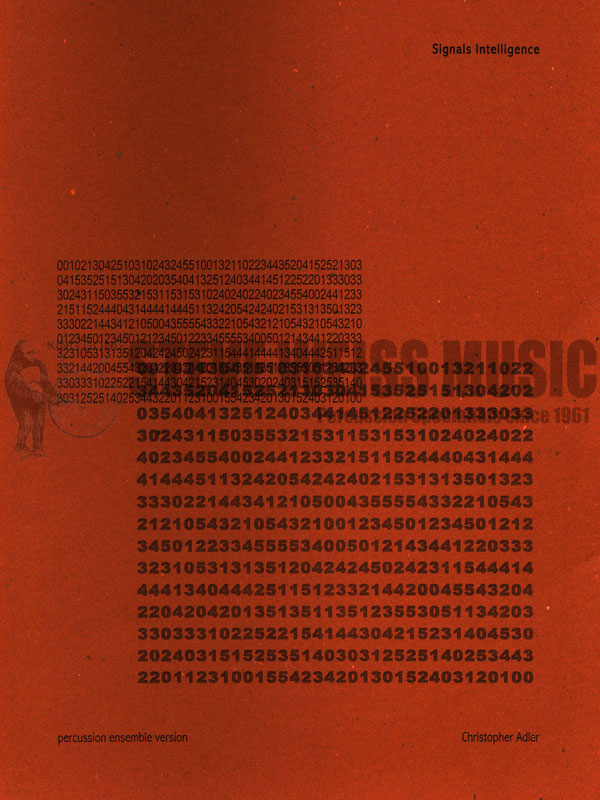
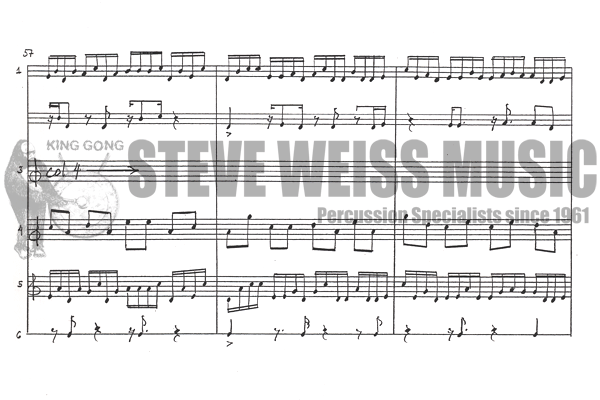
Signals Intelligence explores the experience of hearing an electronic transmission in which order is clearly audible but the information density is too high for any human to parse. The experience is one of being made aware of that which is always just out of reach, just beyond comprehension. Two related algorithms are employed to generate melodic material using from one to six pitches. One algorithm generates a self-similar series which replicates itself when played at different speeds, in effect comprising a mensuration canon in compound melody. The second algorithm generates a self-similar series which is also non-retrogradable (identical when played in reverse order). In the solo version, the results are applied to six indefinitely pitched objects, while in the ensemble version these are mapped to shifting pitch sets and presented in combination with indefinitely pitched instruments.
The ensemble version of Signals Intelligence was commissioned by the Duke University Department of Music for the Milestones 2002 Festival.
The ensemble version of Signals Intelligence has been released on the CD Epilogue for a Dark Day.
Number of Players: 6
Level of Difficulty: Grade 5
Instrumentation:
Player 1: Six objects of the same type, with indefinite pitch, organized in order of ascending pitch. For Example: six brake drums, six woodblocks, or six cowbells.
Player 2: Six objects fitting the same description as above, but of a different type from those of player 1.
Player 3: High definite-pitched instrument with a two octave range, preferably with resonance such as glockenspiel or crotales.
Player 4: Low, definite pitched instrument, such as a marimba, vibraphone of xylophone.
Player 5: Low, definite pitched instrument, such as a marimba, vibraphone of xylophone. Can be the same as player 4
Player 6: Bell plate, kick drum, large bass drum.
Christopher Adler is a composer, performer and improviser living in San Diego, California. His music draws upon over a decade of research into the traditional musics of Thailand and Laos and a background in mathematics. He is a foremost performer of traditional and new music for the khaen, a free-reed mouth organ from Laos and Northeast Thailand. He received Ph.D. and Master's degrees in composition from Duke University and Bachelor's degrees in music composition and in mathematics from the Massachusetts Institute of Technology, and he is currently an Associate Professor at the University of San Diego.
The ensemble version of Signals Intelligence was commissioned by the Duke University Department of Music for the Milestones 2002 Festival.
The ensemble version of Signals Intelligence has been released on the CD Epilogue for a Dark Day.
Number of Players: 6
Level of Difficulty: Grade 5
Instrumentation:
Player 1: Six objects of the same type, with indefinite pitch, organized in order of ascending pitch. For Example: six brake drums, six woodblocks, or six cowbells.
Player 2: Six objects fitting the same description as above, but of a different type from those of player 1.
Player 3: High definite-pitched instrument with a two octave range, preferably with resonance such as glockenspiel or crotales.
Player 4: Low, definite pitched instrument, such as a marimba, vibraphone of xylophone.
Player 5: Low, definite pitched instrument, such as a marimba, vibraphone of xylophone. Can be the same as player 4
Player 6: Bell plate, kick drum, large bass drum.
Christopher Adler is a composer, performer and improviser living in San Diego, California. His music draws upon over a decade of research into the traditional musics of Thailand and Laos and a background in mathematics. He is a foremost performer of traditional and new music for the khaen, a free-reed mouth organ from Laos and Northeast Thailand. He received Ph.D. and Master's degrees in composition from Duke University and Bachelor's degrees in music composition and in mathematics from the Massachusetts Institute of Technology, and he is currently an Associate Professor at the University of San Diego.
Product Info
| SKU | ADLER/SIGNALSE |
|---|
You may also like
Recently viewed
Customer Reviews
This product currently has no reviews.