
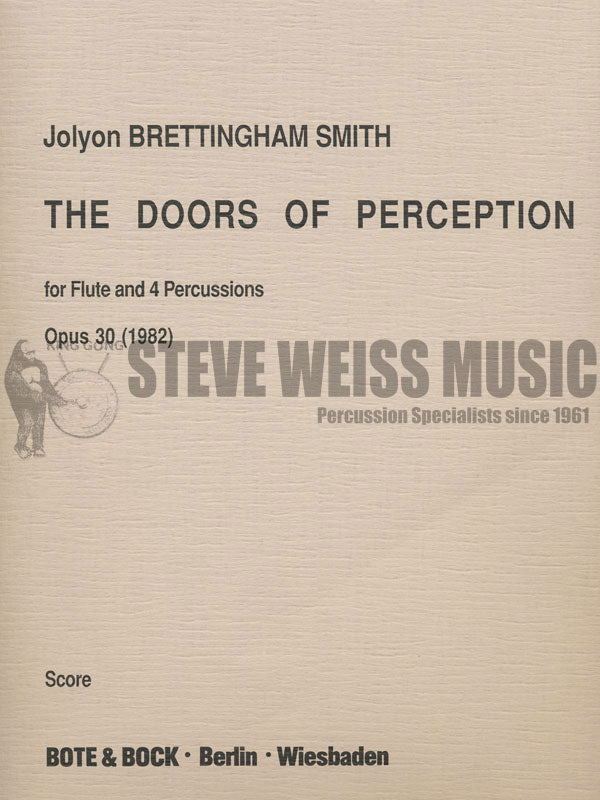
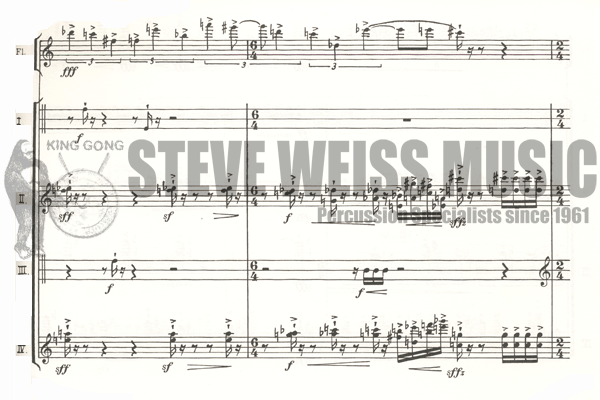


Description
The Doors of pereception was composed in 1982 in response to a commission from members of the Essen Philharmonic Orchestra and was first performed at a concert in the Flokwang Museum. The title of the piece refers ti a famous aphorism of the poet William Blake.
"If the door of perception were cleansed, everything would appear as it is, infinite"
In the case of perception our main "doors of perception" are our ears; and in the meantime they are sorely in need of cleansing...... from the encrusted waxes of tradition, from the merciless bombardments of muzak and advertising jingles, from all the wreckage of a poisoned acoustical environment.
J.B.S
Number of Players: 5
Difficulty: Grade 6
Instrumentation:
Player I: Vibraphone, Med/Low Cymbal, Guiro, Sand Blocks, 3 Woodblocks, 4 Tom-Toms, 3 Triangles, Hi-Hat
Player II: Marimba, High Cymbal, Hi-Hat, 3 Gongs, Tambourine, Rattle, Cylindrical Wood-Drums, 3 Timpani, Chains
Player III: Crash Cymbals, Metal Blocks, Temple Blocks, Quijada, Glass Chimes, Sizzle Cymbal, 3 African Drums, Bass Drum, Carton
Player IV: Xylophone, Med/High Cymbal, 3 Tam-Tams, Bamboo Curtain, Claves, Snare Drum, 3 Bongos
Player V: Glockenspiel, Low Cymbal, Maracas, Castanets, Whip, 2 Congas, Almglocken, Anvil
Jolyon Brettingham Smith was born in Southampton UK 1949. He studied at the Universities of Cambridge (moral sciences), Heidelberg, West-Berlin (musicology and philosophy) and at the Hochschule flir Musik West-Berlin (composition). His main teachers were Derek Bourgeois, Friedhelm Dohl, Ssang Yun.
"If the door of perception were cleansed, everything would appear as it is, infinite"
In the case of perception our main "doors of perception" are our ears; and in the meantime they are sorely in need of cleansing...... from the encrusted waxes of tradition, from the merciless bombardments of muzak and advertising jingles, from all the wreckage of a poisoned acoustical environment.
J.B.S
Number of Players: 5
Difficulty: Grade 6
Instrumentation:
Jolyon Brettingham Smith was born in Southampton UK 1949. He studied at the Universities of Cambridge (moral sciences), Heidelberg, West-Berlin (musicology and philosophy) and at the Hochschule flir Musik West-Berlin (composition). His main teachers were Derek Bourgeois, Friedhelm Dohl, Ssang Yun.
Product Info
| SKU | 511025519 |
|---|
You may also like
Recently viewed
Customer Reviews
This product currently has no reviews.