


Description
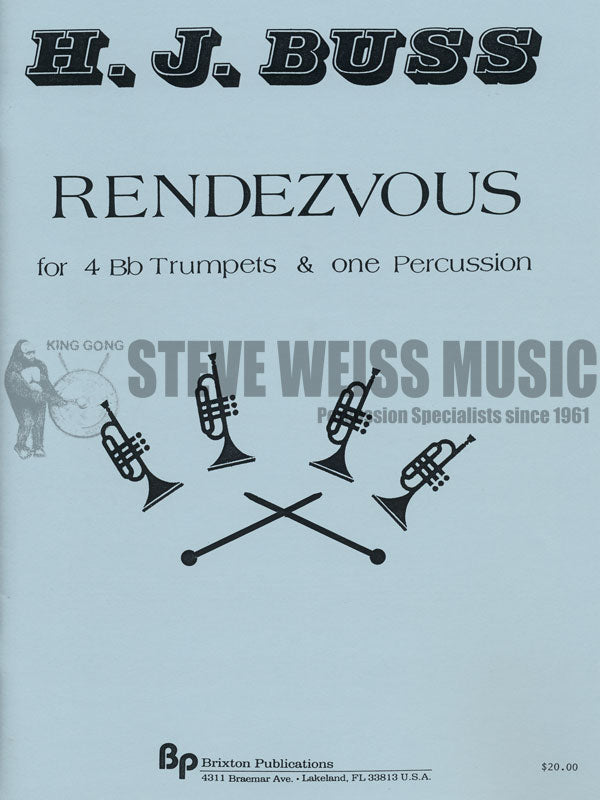
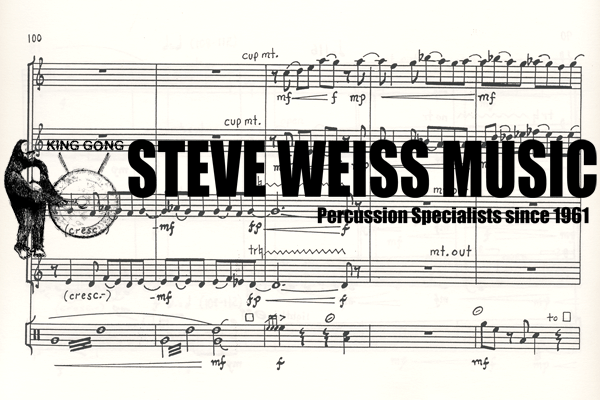
RENDEZVOUS (1994) for four B-flat trumpets and one percussion by Howard J. Buss is a flashy showpiece composed for and premiered at the 1994 International Trumpet Guild Conference. The composition opens with a stirring fugue (the percussionist performs the subject on the xylophone). Following the opening section are an intriguing series of passages featuring contrapuntal writing and the use of ostinati. The work culminates in an intense and exciting finale. Rhythmically and harmonically, the music is influenced by jazz.
The percussion writing employs primarily 2 mallet technique with some use of 4 mallets on the xylophone in a passage of repeated eighth note chords.Rendezvous was first performed on June 18, 1994 during the International Trumpet Guild Conference hosted by the University of Illinois in Urbana with percussionist David Collier and trumpeters James Ketch, Charles Gates, Roy C. Griffen, and Craig Hurst.
Number of Players: 5
Difficulty: Grade 5
Instrumentation:
Player I: Trumpet 1
Player II: Trumpet 2
Player III: Trumpet 3
Player IV: Trumpet 4
Player V: Xylophone, 2 Suspended Cymbals, 5 Temple Blocks, Tam-Tam, Finger Cymbals
Howard J. Buss (b. 1951) is recognized internationally as a significant composer of contemporary classical music. His compositions have received critical acclaim and have been performed in more than 50 countries. His music is widely performed and frequently featured at national and international music conventions and festivals. They have been performed by faculty musicians from major universities as well as current and former members of prestigious organizations such as The Boston Symphony Orchestra, Minnesota Orchestra, Buffalo Philharmonic, Israel Philharmonic, Berlin Philharmonic, Vancouver Symphony, Atlanta Symphony, New York Philharmonic, Chicago Symphony, etc. A copy of his patriotic composition Fanfares is included in the Presidential Collection of Ronald Reagan. Buss' more than 120 published works include instrumental solos, chamber music, symphonic, choral, and band works. They are fast becoming part of the standard repertoire in concert halls.
The percussion writing employs primarily 2 mallet technique with some use of 4 mallets on the xylophone in a passage of repeated eighth note chords.Rendezvous was first performed on June 18, 1994 during the International Trumpet Guild Conference hosted by the University of Illinois in Urbana with percussionist David Collier and trumpeters James Ketch, Charles Gates, Roy C. Griffen, and Craig Hurst.
Number of Players: 5
Difficulty: Grade 5
Instrumentation:
Howard J. Buss (b. 1951) is recognized internationally as a significant composer of contemporary classical music. His compositions have received critical acclaim and have been performed in more than 50 countries. His music is widely performed and frequently featured at national and international music conventions and festivals. They have been performed by faculty musicians from major universities as well as current and former members of prestigious organizations such as The Boston Symphony Orchestra, Minnesota Orchestra, Buffalo Philharmonic, Israel Philharmonic, Berlin Philharmonic, Vancouver Symphony, Atlanta Symphony, New York Philharmonic, Chicago Symphony, etc. A copy of his patriotic composition Fanfares is included in the Presidential Collection of Ronald Reagan. Buss' more than 120 published works include instrumental solos, chamber music, symphonic, choral, and band works. They are fast becoming part of the standard repertoire in concert halls.
Product Info
| SKU | BUSS MUS 135 |
|---|
You may also like
Recently viewed
Customer Reviews
This product currently has no reviews.